
To bring atmospheric carbon (currently 420 parts per million) back to pre-industrial levels (280 ppm), humanity will have to do more than stop emitting greenhouse gases. It will also have to increase the amount of carbon dioxide removed from the atmosphere.
Removing carbon from the atmosphere: six approaches.
What is carbon removal, and how does it differ from carbon avoidance?
Carbon removal is the act — by engineered or natural means — of taking CO₂ out of the atmosphere. Some use the term to mean long-lived storage solutions specifically. For this discussion, we treat carbon removal as the activity of taking CO₂ out of the atmosphere.
Simple as that sounds, it is often confused with other climate mechanisms such as carbon avoidance, which prevents greenhouse gas emissions through a substitute activity — using solar power instead of coal-fired electricity, for instance. Avoidance is sometimes called emission reduction, which does not mean actively lowering the carbon already in the air but lowering the volume of new emissions created.
The Oxford Principles are a useful guide for telling avoidance and removal credits apart. On their definition, avoidance and reduction credits are generated by replacing fossil fuel energy with renewables, and by capturing CO₂ at source (carbon capture at a gas-fired power station, say). Preventing damage to ecosystems also counts as avoidance. Carbon removal credits, by contrast, are defined as credits from projects that "remove carbon dioxide directly from the atmosphere".
Can a carbon credit cover both removal and avoidance?
In many cases a single carbon credit accounts for both. A farmer in a regenerative agriculture programme generating carbon credits may cut fertiliser use — avoiding emissions of nitrous oxide (N₂O), a harmful greenhouse gas — while planting and maintaining cover crops, which increases photosynthesis (natural carbon removal).
Here the regenerative agriculture project as a whole is a mix of removal and avoidance. A single credit generated by that farmer represents the net emissions effect of both activities. Some project developers, standard setters and verifiers are beginning to break removal and avoidance credits out separately, but we are still early in distinguishing projects that both avoid emissions and remove carbon.
Indeed, many of the most innovative climate solutions today do both, including soil carbon, forestry and some concrete mineralisation. That is why Patch follows the guidance set by the Oxford Principles in prioritising a shift towards carbon removal rather than working with it exclusively. The distinctions drawn between climate solutions, such as removal and avoidance, are rarely binary; they sit on a spectrum. Bringing out that nuance is what allows informed climate action to scale quickly.
Short-lived and long-lived carbon storage
For both removal and avoidance credits, the Oxford Principles also distinguish how long the carbon will be stored. Short-lived storage may sequester carbon for decades; long-lived storage may sequester it for millennia. Just as the principles encourage a shift towards removal, they encourage a shift from short-lived to long-lived storage.
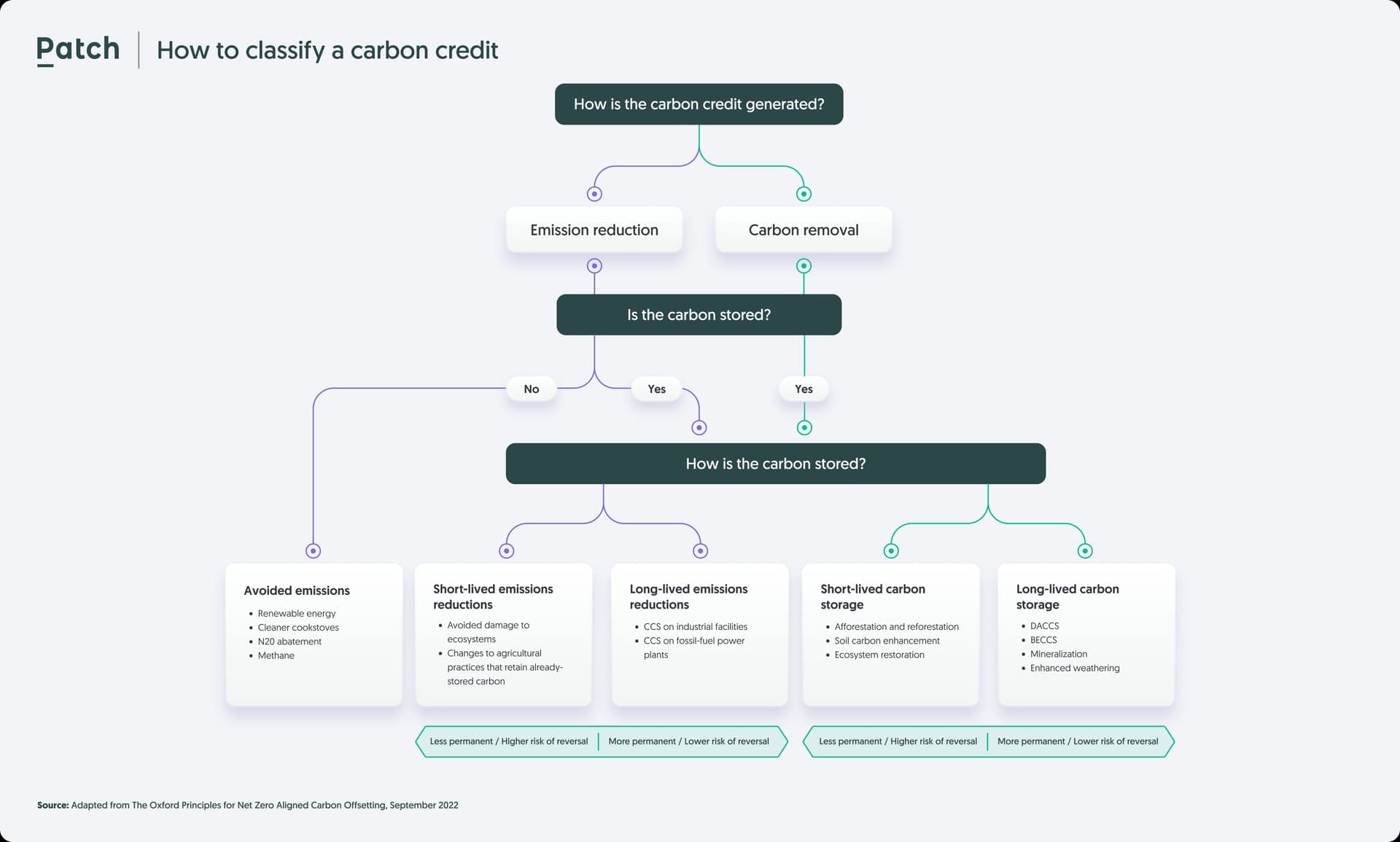
Removal solutions with long-lived storage are the foundation for limiting irreversible climate change. Avoidance still matters enormously, because every tonne of greenhouse gas not emitted is a tonne we do not have to remove.
Nature-based and engineered removal
Nature-based carbon removal refers to the ways ecosystems — plants, soil and the ocean — take carbon out of the atmosphere. Forests are among the best known: trees photosynthesise and absorb carbon as they grow, and forests remove roughly 15.6 billion tonnes of carbon a year. Deforestation and wildfire cut the net figure, but forests still absorb around 1.5 times total US CO₂ emissions. Forest management is one way people can support natural removal, alongside ocean kelp cultivation and regenerative farming.
Engineered removal, by contrast, covers processes people have developed to convert CO₂ molecules in the air into stable forms — liquid, solid or contained gas — for semi-permanent or permanent storage.
Six ways to remove carbon from the atmosphere
Patch groups removal methods into six categories according to how the carbon is removed. Each can contain both nature-based and engineered approaches.
- Forestry
- Ocean-based removal
- Mineralisation
- Biomass
- Soil
- Direct air capture
Choosing the right solution
Useful as these comparisons are, turning off the tap and opening the greenhouse window is harder than it looks.
Nature-based solutions offer immediate action on emissions and often bring additional ecosystem benefits, but on their own they cannot save us from climate catastrophe. Relying on them alone would also demand land that is needed for food production and livelihoods.
Engineered "frontier solutions", meanwhile, can deliver effective long-term removal and sequestration, but remain early in development while they wait on the investment that brings scale. As with solar — an expensive technology before it made a large dent in our collective emissions — prices fall as supply grows. Planting forest may be cheaper today, but air capture technologies may deliver more efficient capture at lower cost by the time those forests mature.
Nature-based and engineered solutions both have value, and both will be needed to meet global climate goals. For anyone looking to scale long-term removal, though, the advanced technologies usually offer the greatest effect.
About the author
- Robert Ralph leads Partnerships at Patch, working closely with both traditional and frontier project developers who use Patch to secure their success in the carbon market. He brings deep operational and strategic experience from Oliver Wyman and IESE Business School, where he built growth strategies and delivered effective solutions for leading Fortune 500 businesses and early-stage startups.
Source: patch.io, by Robert Ralph
Updated September 5, 2026