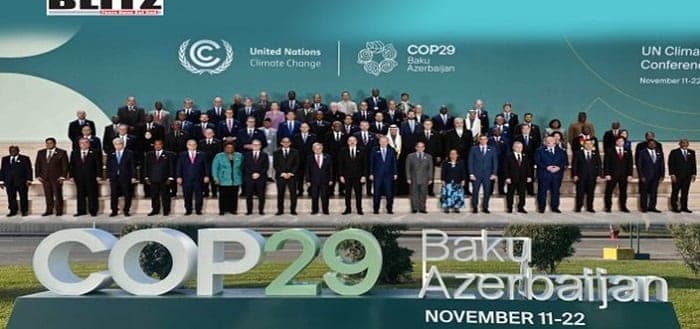
The 29th Conference of the Parties to the UN Framework Convention on Climate Change (COP29) ran from 11 to 24 November 2024 in Baku, Azerbaijan, a significant moment in the global response to climate change. Yet for all the size of the financial commitments, COP29 ended in division and argument between developed and developing countries. The finance agreed, while treated as an important step, fell short of what countries facing climate impacts had expected, raising hard questions about how workable and how fair these global solutions really are.
The finance agreed at COP29. The conference adopted a climate finance agreement committing USD 300 billion a year to developing countries, to help them cut emissions and adapt to climate impacts. It is a notable sum, and many countries — developing countries above all — still regard it as insufficient. Finance is the pivot of climate negotiations, since wealthier countries carry a responsibility to support poorer ones in a fight whose causes they largely did not create.
India's representative, Chandni Raina, called the agreement "abysmal" and said it could not meet the urgency of the climate challenge. She argued further that the way it was adopted did not follow the UNFCCC's proper consensus procedure. Delegates from small and least developed countries expressed the same disappointment, saying the deal broke three years of hopeful negotiation and eroded trust in the UN climate process.
How developed countries responded
Developed countries argued that USD 300 billion a year is a substantial advance on the previous commitment of USD 100 billion. In the current political climate, they said, it was the most that could realistically be pledged. They also acknowledged that more work is needed to mobilise resources towards the long-term goal of USD 1.3 trillion — the figure they consider necessary to address the challenge in earnest.
Even with agreement on the number, the split between developed and developing countries over the fairness of the deal remained plain. The United States, Europe and Japan countered that demands of that scale could strain a global economy already under pressure. The result was disagreement over how climate finance should be resolved at all, deepening the sense of unfairness and division.
The difficulty of mobilising private capital
One of the central issues at COP29 was unlocking private finance, particularly between developed and developing countries. France's ambassador to the OECD, Amélie de Montchalin, told the ISCFS-2024 conference that the world needs USD 1 trillion a year flowing from advanced economies into emerging markets and developing economies by 2030, against roughly USD 150 billion today. That target represents just 1% of global financial assets — not a large share, but very hard to reach as things stand.
She noted that European investors hold only 2.2% of their portfolios in emerging and developing economies, a figure that shows how little attention and capital reaches the regions bearing the heaviest climate impacts. That shortfall is not only a financial problem but a question of global fairness. Her proposal was that multilateral development banks should act as partners to private finance, to build sustainable energy markets in developing countries.
What the agreement amounts to
The finance agreed at COP29 does not meet the demands developing countries brought to the table, but its adoption is nonetheless treated as an important step in the global response. Professor Ottmar Edenhofer, a climate economist at the Potsdam Institute for Climate Impact Research, argued that the most important thing about the agreement is that it passed at all: it averted a diplomatic collapse and set a footing for the negotiations to come.
Meeting COP29's longer-term goals, and addressing global climate problems, still leaves a great deal of work. Developed and developing countries need to work together more closely — not only on mobilising finance, but on the technology and policy that reduce greenhouse gas emissions and support adaptation.
COP29 made some progress on climate finance while opening up much argument about how fair and how feasible the commitments are. The division between developed and developing countries persists, above all over raising the capital the global challenge requires. Adopting the finance agreement was still a turning point: it opens the way to the next round of negotiations and calls for stronger international cooperation. Countries and international financial institutions alike need to keep working towards long-term climate goals, and towards a future the next generation can live in.
P.A.T (NASATI), after Euronews, November 2024
Updated September 5, 2026